





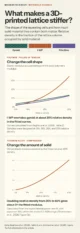
The stiffness of a 3D-printed lattice depends on its repeating geometry and how much of its volume is solid. In polymer tensile tests, the fitted curve for the I-WP lattice overtook the gyroid at about 20% relative density (Baghous et al., 2026).
In a separate compression study on titanium-alloy gyroids, increasing relative density from 30% to 60% roughly tripled the fitted elastic modulus. Each panel uses the scale and test conditions appropriate to its experiment (Zimmerman et al., 2026).
References
Baghous, N., Abraham, M. A., Mogos, N. T., & Abu Al-Rub, R. K. (2026). Tensile properties of sheet-based triply periodic minimal surface lattices fabricated using vat polymerization. Scientific Reports, 16, Article 2898. https://doi.org/10.1038/s41598-025-32819-9
Zimmerman, B. K., Carlton, H. D., Lind, J., Kerr, J., Bellino, J. S., & Kumar, M. (2026). Investigating property-porosity relationships for micro-architected lattice structures. Scientific Reports, 16, Article 5521. https://doi.org/10.1038/s41598-026-35262-6
Banner credit
3D printed bioglass lattice, SEM by Ezra Feilden, Wellcome Collection. CC BY 4.0. Cropped, toned, vignetted and lightly smoothed for WebP compression. Illustrative bioglass specimen.


