




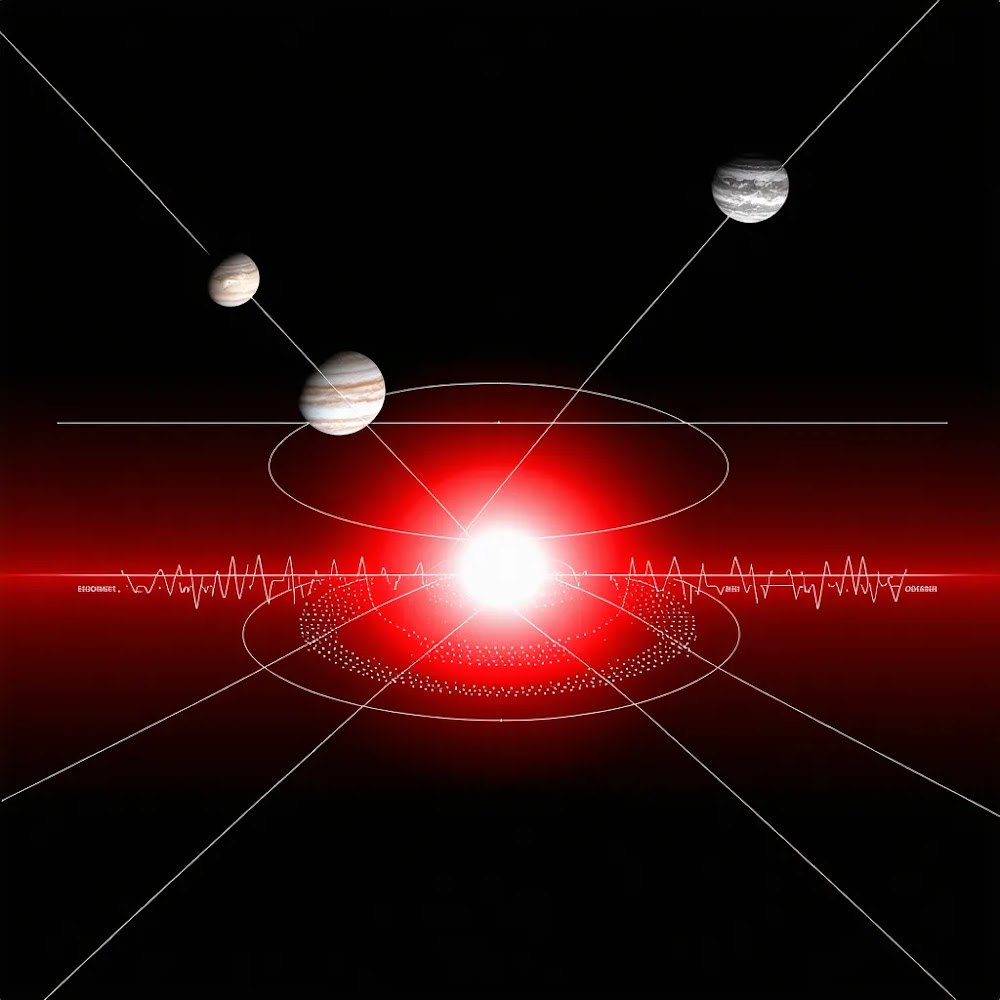

Four small planets discovered around one of the closest stars to Earth – an expert explains what we know
A Quiet Neighbor in the Cosmos
Barnard’s Star is one of the closest stars to Earth—just six light-years away—but too faint to see without a telescope. It’s a red dwarf, smaller than the Sun and closer in size to Jupiter.

“Barnard'sStarSize en” by Marskell, Poppy, User:Richard-59 is licensed under CC BY-SA 3.0 

 .
.
Finding the Unseeable
Astronomers detected four planets orbiting Barnard’s Star using high-precision spectrographs. These instruments detect the tiny wobbles in the star’s motion caused by the planets’ gravity.
The Challenge of Stellar Activity
Red dwarf stars have intense magnetic storms that can mimic planet signals. Scientists must calibrate data carefully to avoid false positives.
Two Teams, Two Telescopes, One Answer
Two independent teams—one in Europe and one in the U.S.—confirmed the four planets by combining seven years of data from different instruments: ESPRESSO and Maroon-X.
Rocky Worlds on the Edge
The four planets orbit tightly around Barnard’s Star, taking just 2 to 7 days to complete a year. They are likely smaller than Earth, rocky, and too hot for liquid water.
No Transits, No Sizes
Because these planets don’t pass between the star and Earth (i.e., don’t transit), scientists can’t directly measure their size or atmospheres—yet.
Red Dwarfs Are Planet Factories
Red dwarfs are the most common stars in the galaxy, and most seem to have planets. This suggests there may be more planets than stars in the Milky Way.

“Artist’s impression of the surface of a super-Earth orbiting Barnard’s Star” by ESO/M. Kornmesser is licensed under CC BY 4.0 .
Eyes on the Habitable Zone
Most discovered planets are close-in because they’re easier to detect. ESA’s Plato mission (launching 2026) aims to find planets farther out—possibly like Earth.


