





Bridging the Gap: A Look at Transitional Fossils
What Are Transitional Fossils?
Fossils, the preserved remains of ancient life, provide a fascinating glimpse into Earth’s evolutionary history. Transitional fossils are especially important because they bridge the gap between ancestral species and their descendants by showcasing characteristics from both groups. They are like snapshots in the long, gradual journey of evolution, revealing how major adaptations arise over millions of years.

“T-rex fossil Jane by Volkan Yuksel DSC08683g” by Volkan Yuksel is licensed under CC BY-SA 3.0 

 .
.
A Theory’s Missing Piece
When Charles Darwin published “On the Origin of Species” in 1859, he acknowledged the lack of transitional fossils as a challenge to his theory. However, just two years later, the discovery of Archaeopteryx—a creature with both dinosaur and bird features—provided powerful evidence. Since then, countless other transitional fossils have been found, helping us map the branching tree of life.
Archaeopteryx: The ‘Primeval Bird’
Living 150 million years ago, Archaeopteryx is one of the most famous transitional fossils. Despite its bird-like feathers, it possessed features of small dinosaurs, including teeth, a flat breastbone, and a long, bony tail. This mix of traits shows a clear link between non-avian dinosaurs and modern birds, playing a crucial role in confirming Darwin’s theories of evolution.

“Day 20 – Archaeopteryx” by akhenatenator is marked with CC0 1.0  .
.
Tiktaalik: From Fin to Limb
Discovered in 2004, Tiktaalik is an ancient fish from 375 million years ago that blurred the line between aquatic and land animals. It had fish-like gills, scales, and fins, but its front fins had a bone structure similar to a wrist, allowing it to prop itself up in shallow water. This “fishapod” is a key ancestor to all four-legged land animals, including amphibians, reptiles, and mammals.
Pakicetids: The First Whales
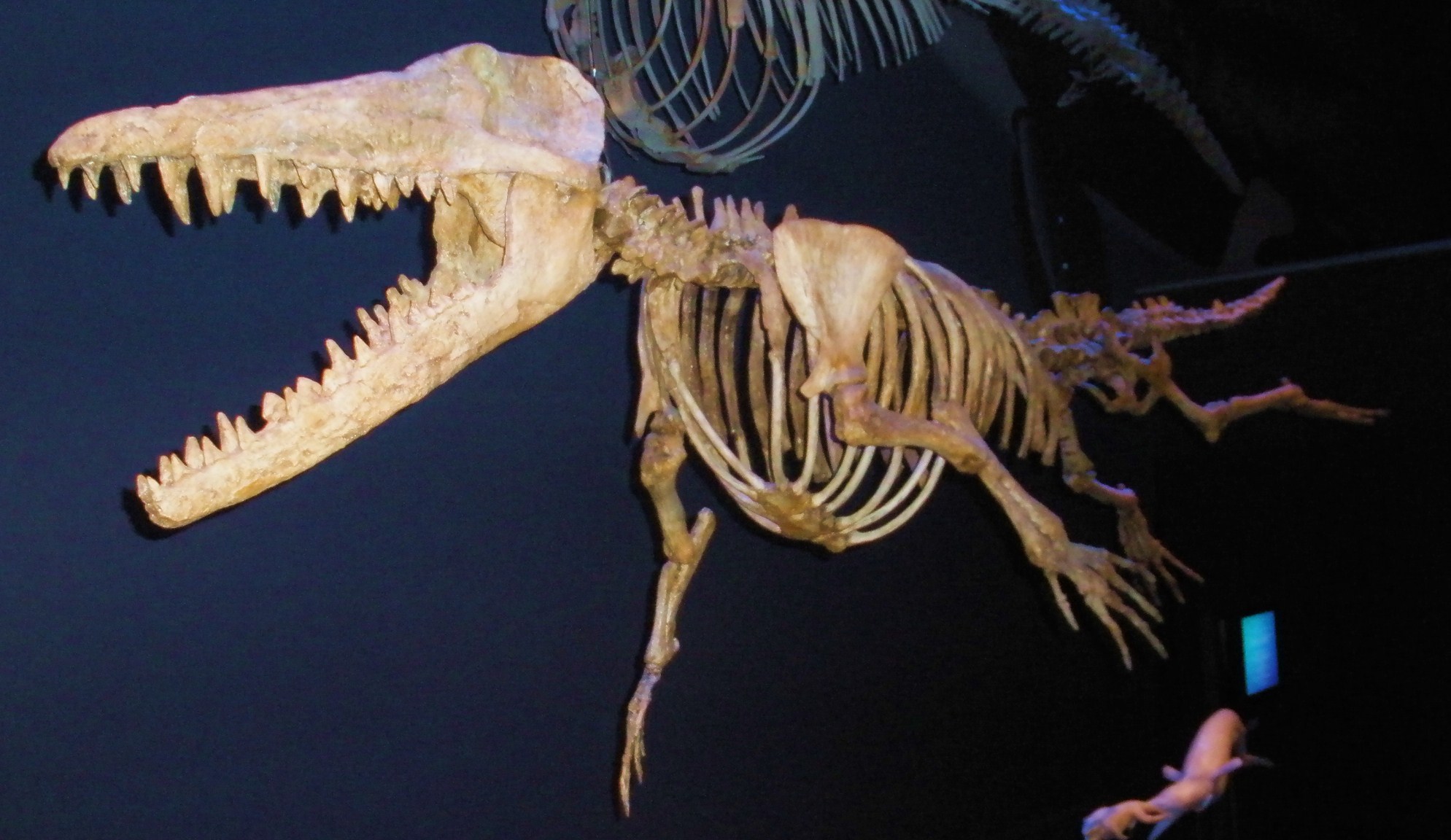
The family Pakicetidae, or “Pakistani whales,” were wolf-sized, land-dwelling mammals from 50 million years ago. Though they had long limbs, their inner ear bones and specialized teeth were distinctly whale-like. Fossils found near freshwater deposits suggest they lived on land but hunted in shallow water, representing the very first step in the evolution of whales from terrestrial mammals to fully aquatic giants.

“Pakicetus Canada” by Kevin Guertin from Ottawa, Ontario, Canada is licensed under CC BY-SA 2.0 .
An Incomplete, Branching Story
It is important to remember that not all organisms fossilize, so the fossil record remains incomplete. Furthermore, evolution is not a straight line but a complex, branching tree. A transitional fossil is not necessarily a direct ancestor of a modern species but rather an early offshoot that shows features shared with a common ancestor. They provide invaluable clues to the intricate and ongoing story of life on Earth.