






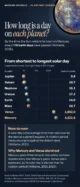
NASA’s planetary fact sheet gives Earth a 24-hour solar day, compared with 9.9 hours on Jupiter and 4,222.6 hours on Mercury (Williams, 2025).
A solar day is the average time from one noon to the next at a planet’s equator. Mercury spins three times in two orbits, so a solar day lasts two Mercury years. Venus rotates backward, which makes its solar day shorter than its rotation period (Williams, 2021, 2025).
References
NASA, Johns Hopkins University Applied Physics Laboratory, & Carnegie Institution of Washington. (2013, February 18). Colors of the innermost planet: View 1 [Photograph]. NASA Science. https://science.nasa.gov/photojournal/colors-of-the-innermost-planet-view-1/
Williams, D. R. (2021, December 20). Planetary fact sheet notes. NASA Space Science Data Coordinated Archive. https://nssdc.gsfc.nasa.gov/planetary/factsheet/planetfact_notes.html
Williams, D. R. (2025, March 18). Planetary fact sheet – Metric. NASA Space Science Data Coordinated Archive. https://nssdc.gsfc.nasa.gov/planetary/factsheet/
Banner credit
Colors of the Innermost Planet: View 1 by NASA / Johns Hopkins University Applied Physics Laboratory / Carnegie Institution of Washington. Public domain per USGS. Reframed, brightness and contrast adjusted, and composited onto a navy background.


