At a Glance
- A UC Santa Cruz physicist has published two new theories that re-imagine the origin of dark matter as a gravitational phenomenon in the early universe.
- One model suggests dark matter consists of tiny, stable black holes that formed from the collapse of heavy “dark baryons” in a theoretical “mirror world.”
- The second theory examines whether dark matter particles were created by the universe’s expanding cosmic horizon during a period of rapid post-inflationary expansion.
- These scenarios are significant because they do not require new particle interactions, explaining why experiments have so far failed to detect dark matter directly.
- While speculative, both proposals are grounded in established physics and offer testable new frameworks to explain the universe’s most mysterious substance.
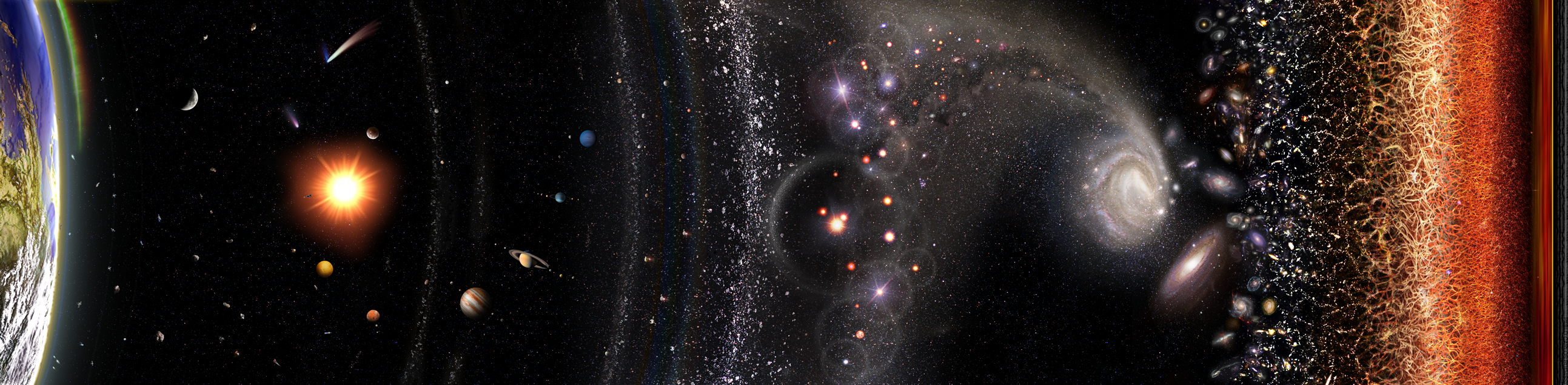
In two recent studies, a physicist at the University of California, Santa Cruz, has proposed novel theories suggesting dark matter is not an exotic new particle but a natural byproduct of the early universe. The research by Professor Stefano Profumo tackles one of physics’ most profound mysteries: the nature of the invisible substance that constitutes 80% of all matter. Published in Physical Review D (1, 2), his work explores how dark matter could have emerged from the fundamental forces of gravity and quantum mechanics during the cosmos’s earliest moments, offering new avenues for a field where traditional models are facing growing challenges due to a lack of experimental evidence.
One theory describes a “mirror world,” a hidden sector of the universe with its unique particles and forces that are invisible to us. Drawing on the established physics of how quarks and gluons form protons and neutrons, this model envisions “dark quarks” and “dark gluons” binding together to form heavy particles known as dark baryons. Profumo’s calculations indicate that, in the extremely dense early universe, these dark baryons could have collapsed under their own gravity to form tiny, stable black holes. These remnants, just a few times heavier than the fundamental Planck mass, could account for all the dark matter observed today while interacting with our world only through gravity.

A second paper explores whether dark matter was radiated into existence by the expanding edge of the observable universe, known as the cosmic horizon. This idea hinges on a brief period of accelerated expansion just after the Big Bang’s initial inflationary burst. Much like a black hole’s event horizon is theorized to emit radiation, the universe’s own horizon could have gravitationally produced stable particles. This mechanism could create dark matter across a vast range of possible masses, depending on the temperature and duration of this expansion phase, without requiring any new, undiscovered interactions between dark matter and normal matter.
“Both mechanisms are highly speculative, but they offer self-contained and calculable scenarios that don’t rely on conventional particle dark matter models, which are increasingly under pressure from null experimental results,” Profumo said in a university press release. While these ideas push the boundaries of theoretical physics, they remain grounded in well-established principles, such as quantum field theory and the behavior of gauge theories. They continue UC Santa Cruz’s long tradition of connecting the most profound questions in particle physics with the large-scale structure of the cosmos, providing a new, testable framework to understand the universe’s shadowy origins.
References
- Peña, M. & University of California-Santa Cruz. (2025, August 4). Theories on dark matter’s origins point to ‘mirror world’ and universe’s edge. Phys.Org; University of California-Santa Cruz. https://phys.org/news/2025-08-theories-dark-mirror-world-universe.html
- Profumo, S. (2025a). Dark baryon black holes. Physical Review D, 111(9), 095010. https://doi.org/10.1103/PhysRevD.111.095010
- Profumo, S. (2025b). Dark matter from quasi–de Sitter horizons. Physical Review D, 112(2), 023511. https://doi.org/10.1103/vmw2-4k77