





At a Glance
- A new study proposes that Leonardo da Vinci’s notes on an equilateral triangle provide the long-sought-after geometric solution for his famous Vitruvian Man drawing.
- The study shows this triangle corresponds to Bonwill’s triangle, a key geometric relationship in modern dentistry that governs the optimal biomechanics of the human jaw.
- This construction yields a ratio of 1.64 to 1.65, closely matching the tetrahedral ratio of 1.633, a mathematical constant found in nature’s most efficient structures.
- Modern measurements of ideal human skull and facial structure also align with this ratio, suggesting Leonardo identified a fundamental principle of ideal human anatomical design.
- The discovery positions the Vitruvian Man as a sophisticated scientific hypothesis, potentially inspiring new research in anatomy, prosthetics, and even Renaissance art history.
For more than 500 years, the precise geometric method behind Leonardo da Vinci’s iconic Vitruvian Man drawing has been one of art’s greatest unsolved mysteries. Now, a new study suggests the Renaissance master encoded the solution in plain sight, using a simple shape to link the human form to a universal blueprint for structural efficiency found throughout nature. The research, published in the Journal of Mathematics and the Arts, proposes that Leonardo’s genius was not just artistic but presciently scientific, anticipating anatomical principles that would not be formally described for centuries.
The key to the puzzle, according to the paper by dentist Rory Mac Sweeney, lies in Leonardo’s notes on the drawing, which explicitly reference an “equilateral triangle” between the figure’s legs. An equilateral triangle is a perfect triangle with three equal sides and angles. The study demonstrates that this shape corresponds precisely to what is known in modern dentistry as Bonwill’s triangle—a geometric relationship connecting the two jaw joints and the chin that governs the optimal, most efficient function of the human jaw. By applying this triangle, Leonardo may have been documenting a fundamental principle of human biomechanics, the study of how living things move.
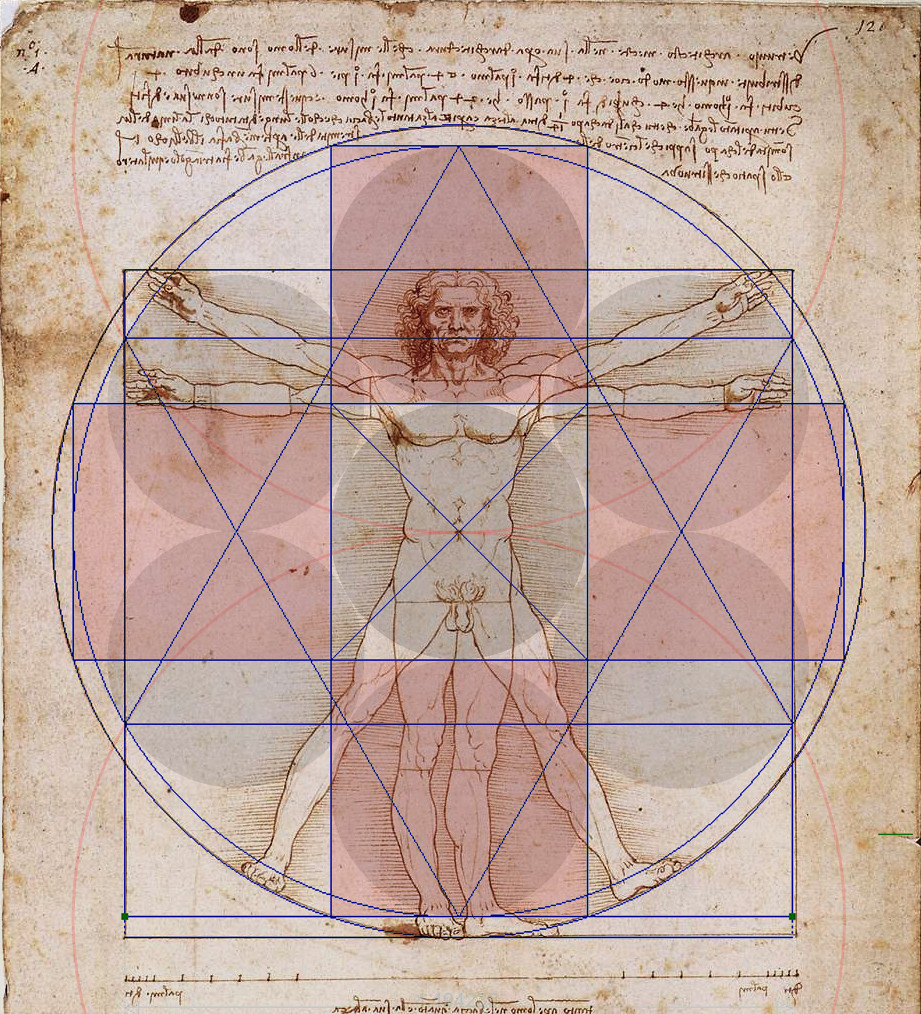
This geometric construction results in a ratio of approximately 1.64 to 1.65 between the side of the square and the radius of the circle that encloses the figure. This value is remarkably close to the tetrahedral ratio of 1.633, a mathematical constant that appears in nature’s most efficient designs, such as the densest way to pack spheres. A tetrahedron is a pyramid with a triangular base, and this ratio defines its ideal proportions. This same mathematical relationship is also found in modern measurements of optimal human craniofacial architecture—the structure of the skull and face—which suggests Leonardo identified a foundational geometric rule governing ideal human anatomy.
By bridging art history with modern science, the findings position the Vitruvian Man as both a masterpiece and a sophisticated scientific hypothesis. “Leonardo’s geometric construction successfully encoded fundamental spatial relationships in human form, demonstrating the remarkable precision of his Renaissance vision of mathematical unity between the human figure and natural order,” Mac Sweeney stated in his paper. Beyond solving an age-old academic question, this discovery could inspire new approaches in fields like prosthetic design and craniofacial surgery, and may encourage researchers to re-examine other Renaissance works for scientific insights hidden for centuries.
References
- Arnold, P. & Phys.org. (2025, July 2). Dentist may have solved 500-year-old mystery in da Vinci’s iconic Vitruvian Man. Phys.Org; Phys.org. https://phys.org/news/2025-07-dentist-year-mystery-da-vinci.html
- Sweeney, R. M. (2025). Leonardo’s Vitruvian Man: Modern craniofacial anatomical analysis reveals a possible solution to the 500-year-old mystery. Journal of Mathematics and the Arts, 1–13. https://doi.org/10.1080/17513472.2025.2507568


