





At a Glance
- An international team of scientists developed a powerful artificial intelligence to analyze Event Horizon Telescope data, uncovering new secrets about the supermassive black holes in two galaxies.
- This advanced AI was trained using nearly one million synthetic datasets generated from complex computer models that simulate the physics of black holes and their surrounding superheated plasma.
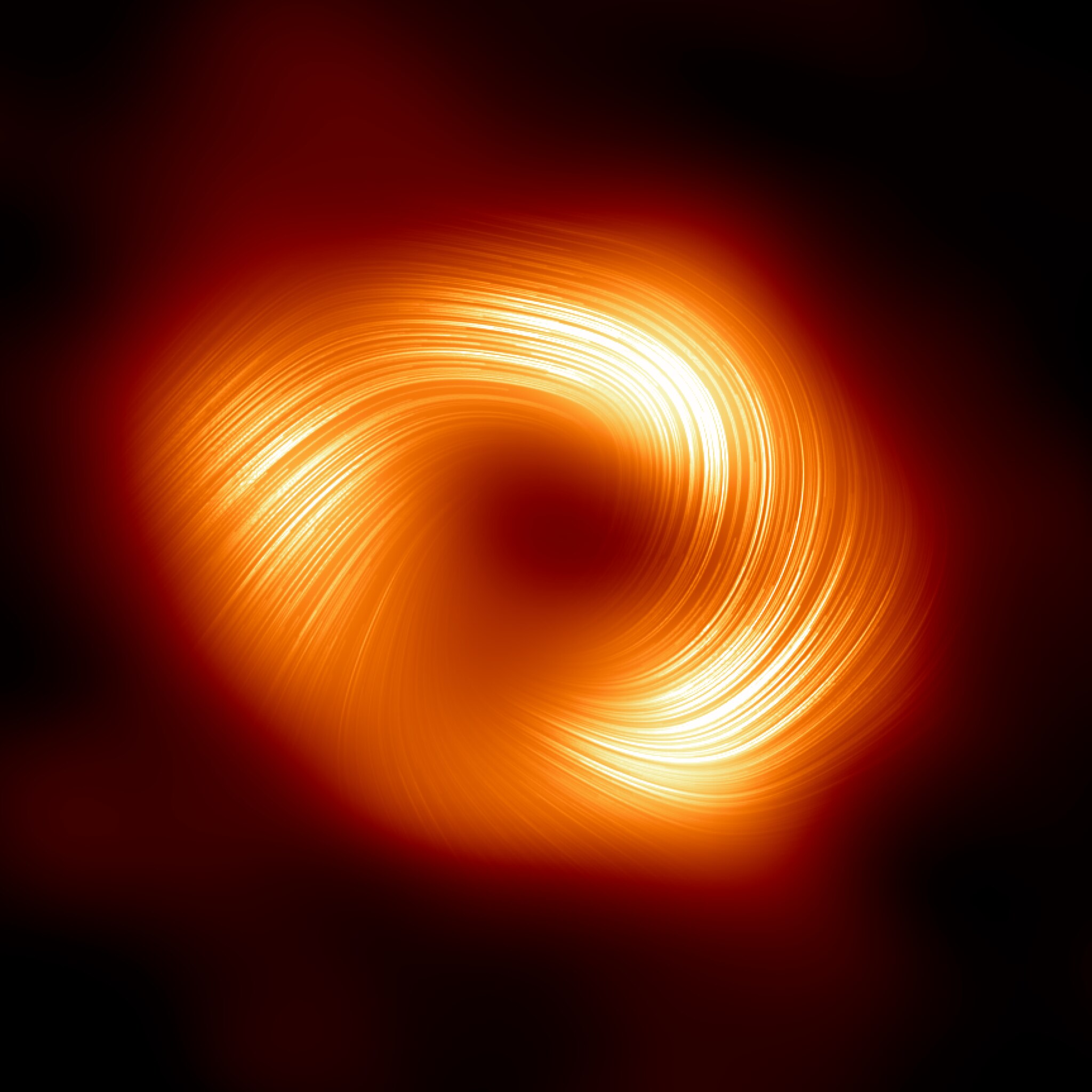
- The analysis revealed that the Milky Way’s central black hole, Sagittarius A*, rotates at almost its maximum theoretical speed with its surrounding matter swirling in the same prograde direction.
- In contrast, the black hole in galaxy Messier 87 spins rapidly in the opposite direction of its accretion disk, a finding that points toward a past galactic merger.
- Researchers anticipate that future telescope upgrades will improve the AI’s accuracy, enabling even more stringent tests of Einstein’s theory of general relativity in extreme cosmic environments.
An international team of researchers has utilized powerful artificial intelligence to analyze data from the Event Horizon Telescope, revealing new details about the supermassive black holes at the centers of our galaxy and the galaxy Messier 87. According to their findings, published across three papers in the journal Astronomy & Astrophysics, the black hole in the Milky Way, known as Sagittarius A*, is spinning at nearly its maximum possible speed. This work provides the most precise measurements to date for the properties of these enigmatic cosmic objects.

The new approach overcomes the limitations of previous analyses by combining a massive library of simulated black hole observations with a custom-built AI. Researchers first generated nearly one million synthetic datasets using general relativistic magnetohydrodynamic (GRMHD) simulations. These complex computer models account for the effects of gravity and magnetic fields on the superheated gas, or plasma, that orbits a black hole. They then used this vast library to train a “Bayesian neural network,” a type of artificial intelligence designed to find the best match between simulations and real data and quantify the uncertainty of its conclusions. This framework, called ZINGULARITY, can sift through the EHT’s complex data to extract subtle physical details.
Applying this powerful tool to 2017 data from the EHT, the team inferred several key properties of the two black holes. They found that Sagittarius A* has a high spin between 80% and 90% of its theoretical maximum and that its accretion disk — the swirling ring of matter falling into it — rotates in the same direction as the black hole itself, a “prograde” flow. For Messier 87*, the black hole at the center of galaxy M87, the results indicate a similarly high spin but with a “retrograde” flow, meaning the black hole spins in the opposite direction to its surrounding disk. The team suggests this counter-rotation could be evidence of a past galactic merger.
This new AI-driven method represents a significant advance in interpreting data from the EHT, allowing scientists to obtain precise measurements that were previously out of reach. The researchers note that their results largely agree with constraints from other astronomical observations, adding confidence to their findings. Looking ahead, the team anticipates even greater accuracy with future upgrades to the telescope network, such as the inclusion of the upcoming Africa Millimeter Telescope in Namibia. They predict this expansion will reduce measurement errors significantly, enabling more stringent tests of Einstein’s theory of general relativity in the extreme environment around supermassive black holes.
References
- Janssen, M., Chan, C. -k., Davelaar, J., Natarajan, I., Olivares, H., Ripperda, B., Röder, J., Rynge, M., & Wielgus, M. (2025). Deep learning inference with the Event Horizon Telescope: I. Calibration improvements and a comprehensive synthetic data library. Astronomy & Astrophysics, 698, A60. https://doi.org/10.1051/0004-6361/202553784
- Janssen, M., Chan, C. -k., Davelaar, J., & Wielgus, M. (2025a). Deep learning inference with the Event Horizon Telescope: II. The ZINGULARITY framework for Bayesian artificial neural networks. Astronomy & Astrophysics, 698, A61. https://doi.org/10.1051/0004-6361/202553785
- Janssen, M., Chan, C. -k., Davelaar, J., & Wielgus, M. (2025b). Deep learning inference with the Event Horizon Telescope: III. ZINGULARITY results from the 2017 observations and predictions for future array expansions. Astronomy & Astrophysics, 698, A62. https://doi.org/10.1051/0004-6361/202553786
- Netherlands Research School for Astronomy. (2025, June 6). Self-learning neural network cracks iconic black holes. Phys.Org; Netherlands Research School for Astronomy. https://phys.org/news/2025-06-neural-network-iconic-black-holes.html


